E-mail Marketing na Era da IA: Domine Personalização, Automação e Entregabilidade
A inteligência artificial está remodelando o panorama do e-mail marketing, mas a maioria das equipes direciona seus esforços para a criação de conteúdo, negligenciando áreas críticas. O verdadeiro potencial reside na otimização da personalização, automação e entregabilidade, pilares que comprovadamente impulsionam a receita. Este artigo explora como integrar essas frentes para construir um sistema de e-mail marketing eficaz e rentável na era da IA.
Atualizado em 10 de maio de 2024 • Leitura estimada: 10 min
Resumo rápido
- A IA no e-mail marketing foca muito na criação de conteúdo, mas os maiores retornos estão na personalização, automação e garantindo que o e-mail chegue ao destinatário.
- A personalização evolui de segmentos amplos para o direcionamento preditivo e individualizado, usando dados para antecipar o comportamento do cliente.
- Empresas com programas de e-mail avançados direcionam a maior parte da receita para automação, e a entregabilidade é crucial, pois quase 20% dos e-mails não chegam à caixa de entrada.
O que aconteceu
Notavelmente, muitas equipes de marketing têm intensificado o volume de e-mails enviados, mas os resultados financeiros e de engajamento permanecem estagnados. O problema reside em uma aplicação equivocada da inteligência artificial: enquanto a maioria utiliza a IA para gerar mais conteúdo, a oportunidade real está em compreender a intenção do consumidor, automatizar decisões estratégicas e personalizar experiências em grande escala.
Este desvio de foco impede que as empresas capitalizem sobre os verdadeiros motores de receita do e-mail marketing: personalização avançada, automação inteligente e, crucialmente, a entregabilidade. Em um cenário digital onde a IA facilita a criação massiva de conteúdo, as caixas de entrada se tornam mais ruidosas, tornando a relevância e a entrega efetiva mais desafiadoras do que nunca. A integração harmoniosa desses três pilares é essencial para construir um sistema que se auto reforça e gera resultados consistentes.
Marketing teams are under real pressure right now: do more with fewer resources, scale personalization, improve retention and lifetime value, and increase marketing efficiency, all at once. AI looks like the obvious answer.
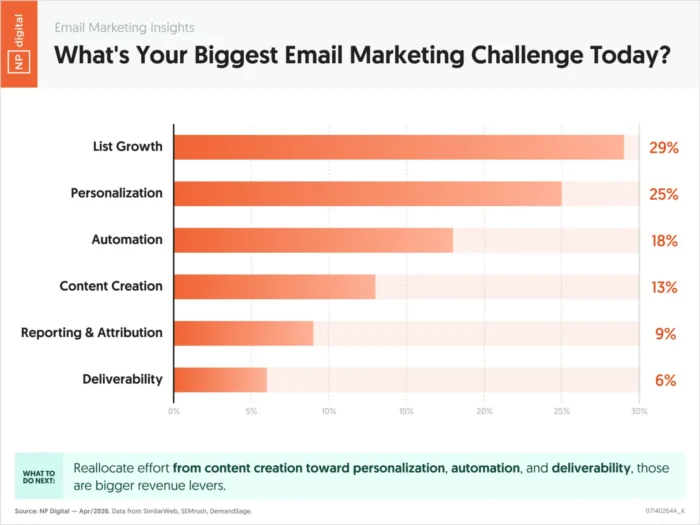
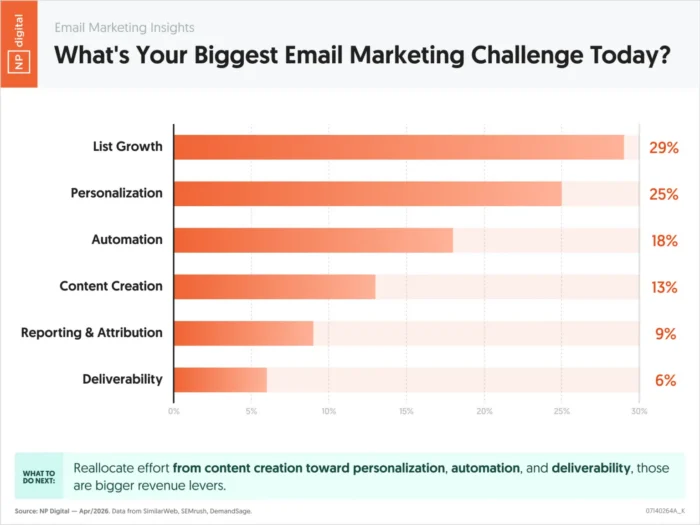
The problem is where that AI effort is actually going. Ask marketers what their biggest email challenge is today, and list growth tops the list at 29 percent, followed by personalization at 25 percent. Deliverability comes in last, at just 6 percent, even though it’s the foundation everything else depends on. An email that never reaches the inbox can’t be personalized or well-timed enough to matter.
Ponto-chave
O sucesso duradouro no e-mail marketing da era da IA exige a integração sinérgica de personalização, automação e entregabilidade em um sistema unificado, onde cada componente amplifica o impacto dos demais.
Por que isso importa
Em um ambiente de negócios cada vez mais competitivo, equipes de marketing enfrentam a pressão constante de maximizar resultados com recursos limitados, escalar a personalização, aprimorar a retenção de clientes e o valor de vida útil (LTV), e otimizar a eficiência global do marketing. A inteligência artificial surge como uma solução promissora para esses desafios.
No entanto, a eficácia da IA depende de seu direcionamento estratégico. Pesquisas indicam que, enquanto desafios como crescimento da lista (29%) e personalização (25%) dominam as preocupações dos profissionais, a entregabilidade é frequentemente subestimada, sendo mencionada por apenas 6%. Este é um erro crítico, pois um e-mail que não chega à caixa de entrada não pode ser personalizado, automatizado ou gerar qualquer valor. A verdadeira otimização reside em uma abordagem integrada que garanta a mensagem certa (personalização), no momento certo (automação), chegando ao destino certo (entregabilidade). Ignorar um desses pilares anula os esforços nos outros.
Here’s how the pieces break down:
- Personalization: delivering the right message.
- Automation: delivering it at the right moment.
- Deliverability: making sure it reaches the inbox at all.
You can’t improve these levers in isolation and expect the same lift each time. A gain in one gets erased by a gap in another. Perfect personalization that lands in spam accomplishes nothing, and flawless deliverability paired with generic, one-size-fits-all messaging just means more people ignoring an email they did receive.
Personalization in the AI Era
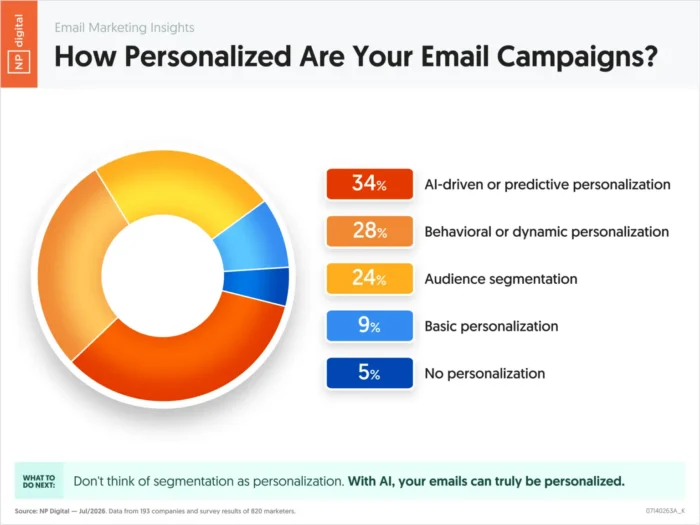
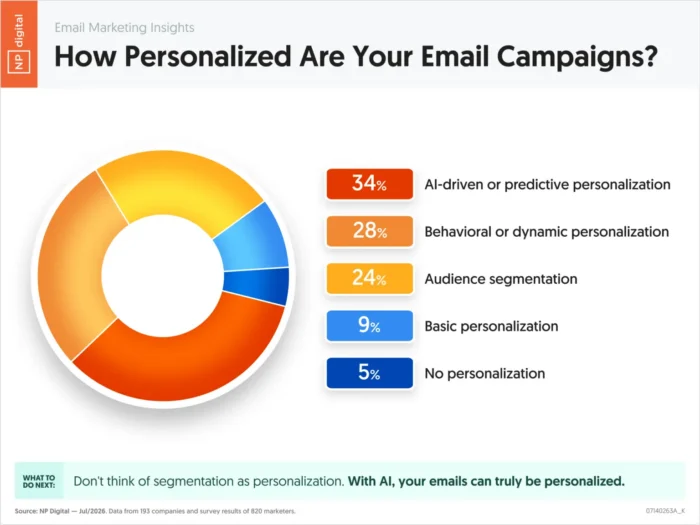
Most brands are stuck in what amounts to a segmentation trap. They personalize using broad buckets, new versus returning customers, geography, industry, demographics, and call it personalization. Only 34 percent of companies actually use AI-driven or predictive email marketing personalization. Another 24 percent are still at basic audience segmentation, and 5 percent use no personalization at all.
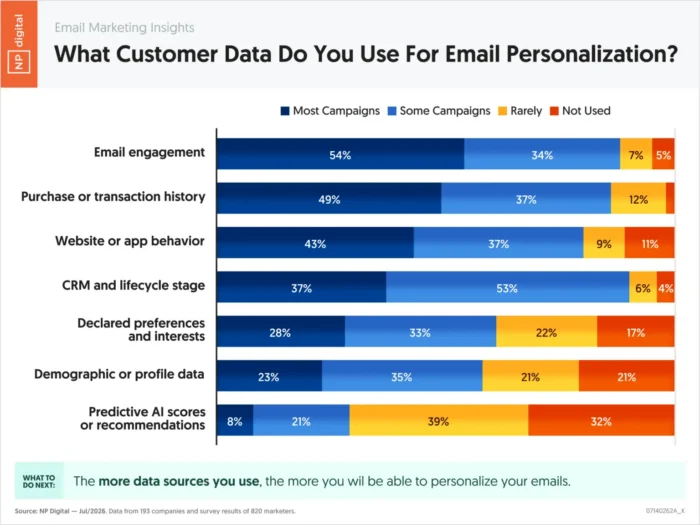
Most teams have the customer data needed for real personalization, they just aren’t using it to predict what happens next. Teams rate themselves strongest in measurement and attribution, with 55 percent calling that capability strong or very advanced. They rate themselves weakest in customer data and identity, at just 37 percent strong or advanced, along with AI skills and governance.
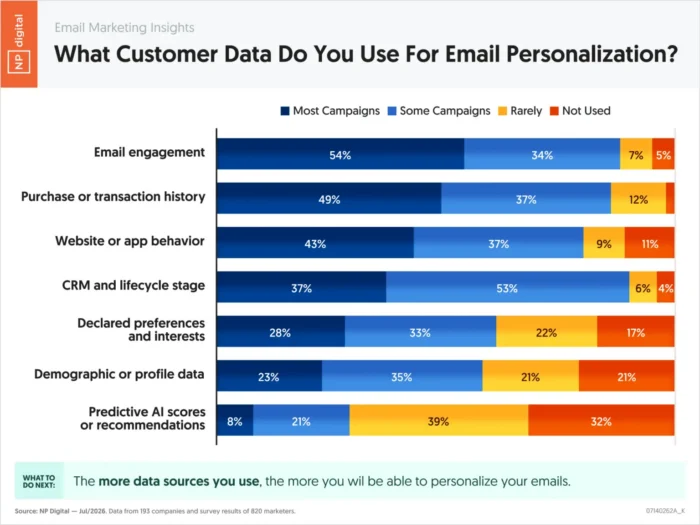
Personalization moves through three stages. Demographic personalization (location, age, gender) is the easiest to set up but produces broad assumptions and low relevance. Behavioral personalization (products viewed, purchases, engagement) produces higher engagement and better conversion. Predictive personalization goes a step further, using purchase likelihood, churn risk, and lifetime value to guide what happens next.
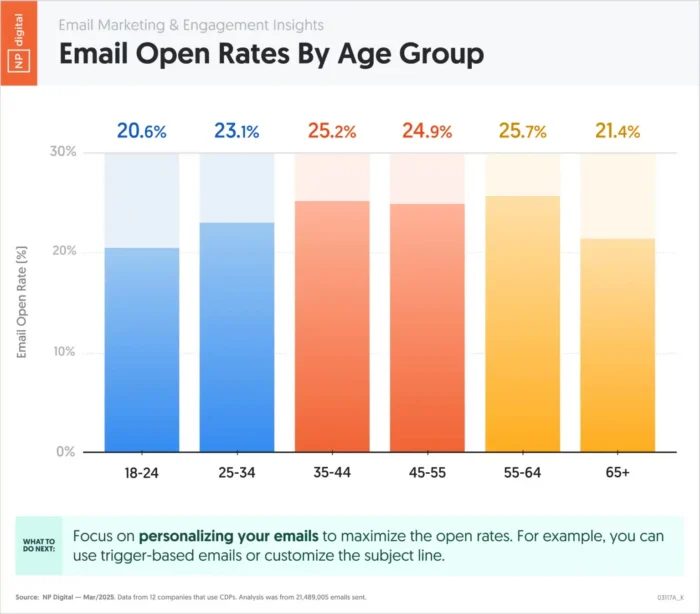
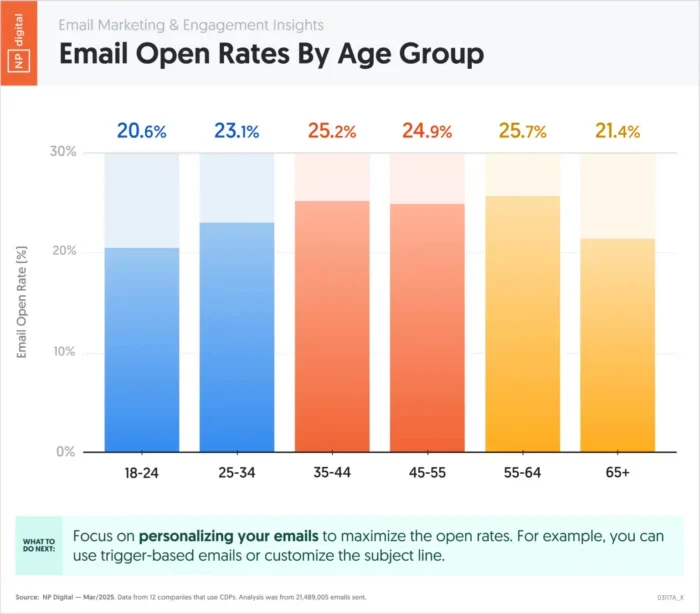
Open rates already vary by age group, from roughly 20.6 percent among 18-24-year-olds up to 25.7 percent among 55-64-year-olds, which makes a strong case for layering behavioral and predictive signals on top of basic demographic segmentation.
Four tactics you can implement this week: dynamic product recommendations based on browsing and purchase history, dynamic content blocks that swap headlines and offers by segment, send-time optimization based on when a subscriber actually engages, and predictive offers built around what a subscriber is likely to buy next.
Impactos práticos
Para empresas
Empresas que adotam a automação em larga escala observam uma mudança significativa na origem da receita, com organizações de maior porte obtendo a maior parte de seus ganhos do e-mail marketing via fluxos automatizados. Isso impulsiona a eficiência operacional, garante consistência na jornada do cliente e evita a perda de oportunidades de receita que campanhas manuais poderiam deixar passar.
Para consumidores
Os consumidores se beneficiam de uma experiência mais relevante e engajadora. A personalização avançada, que transcende dados demográficos e considera o comportamento e a probabilidade de compra, resulta em mensagens que realmente importam. Isso não só aumenta as taxas de abertura e clique, mas também fortalece a confiança na marca e a fidelidade a longo prazo.
Para o mercado
O mercado testemunha uma crescente demanda por ferramentas e plataformas que integrem IA para otimizar os três pilares. Provedores de caixa de entrada estão usando IA para filtrar e-mails, tornando a reputação do remetente e a qualidade da lista fatores decisivos. Empresas que investem em entregabilidade robusta e automação inteligente ganham vantagem competitiva, enquanto aquelas que falham correm o risco de ter suas mensagens ignoradas ou marcadas como spam, perdendo a conexão com seu público.
Automation That Actually Drives Revenue
Campaign marketing runs on a simple loop: campaign, send, repeat. Lifecycle marketing works differently. A customer action triggers an automated response, no one has to remember to hit send.
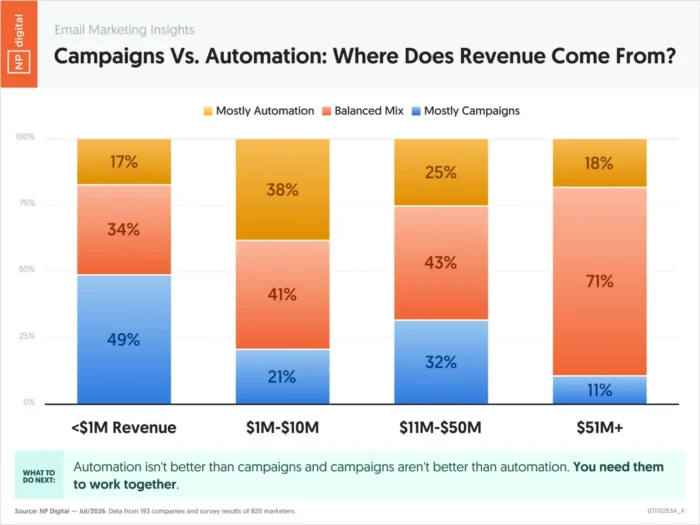
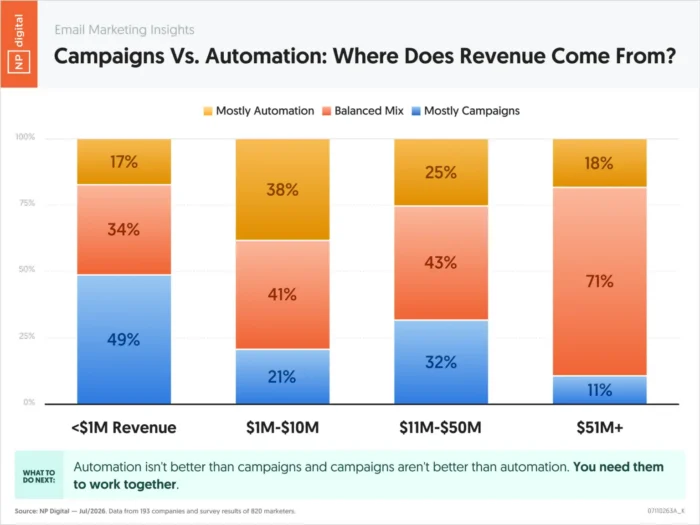
That shift matters more as companies grow. Businesses earning less than $1 million get 49 percent of their email revenue from campaigns. That flips as revenue scales. Companies earning over $51 million get 71 percent of email revenue from automation and just 11 percent from campaigns. Manual scheduling shows up as inconsistent customer journeys, day-to-day operational inefficiency, and revenue a trigger would have caught but a person missed.
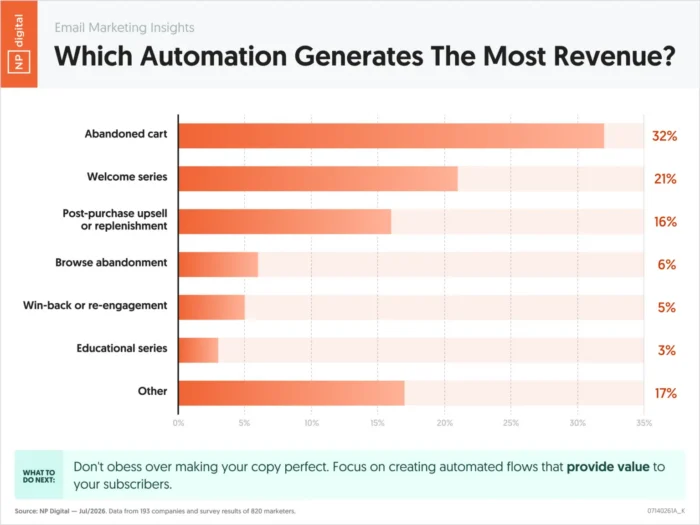
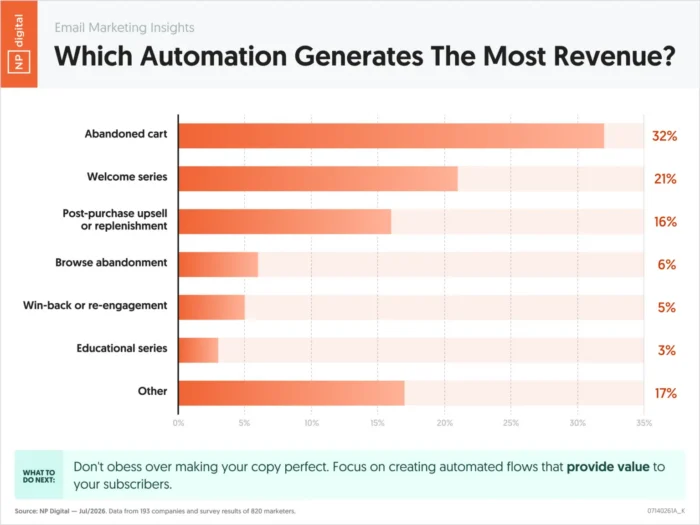
Some automations pull far more weight than others. Abandoned cart drives the largest share of automation revenue at 32 percent, followed by welcome series at 21 percent and post-purchase upsell or replenishment at 16 percent.
Post-purchase flows compound in a way that’s easy to underestimate. Email marketing lifts repurchase rate by 31 percent and shortens time to repurchase by roughly 8 days, and that gain repeats across your entire customer base.
Automation maturity builds in stages. Triggered campaigns just need a trigger to fire. Behavioral automation needs data on what people actually do. Predictive lifecycle marketing needs AI making the calls on timing and offers.
O cenário daqui para frente
O futuro do e-mail marketing delineia uma equipe multifacetada, onde estratégia, dados, automação e inteligência artificial convergem em um fluxo de trabalho coeso e interconectado desde o início. A sinergia entre esses elementos será crucial para maximizar o retorno sobre o investimento e manter a relevância em um cenário digital em constante evolução.
Observa-se uma tendência clara para a personalização preditiva e recomendações avançadas, que já representam a maior fatia do impacto incremental nos negócios (31%) entre as iniciativas de e-mail impulsionadas por IA. Este impacto não é isolado; ele se multiplica à medida que cada nova iniciativa é construída sobre a anterior, criando um efeito composto que eleva o desempenho global do programa de e-mail.
Deliverability: Why Great Emails Still Land in Spam
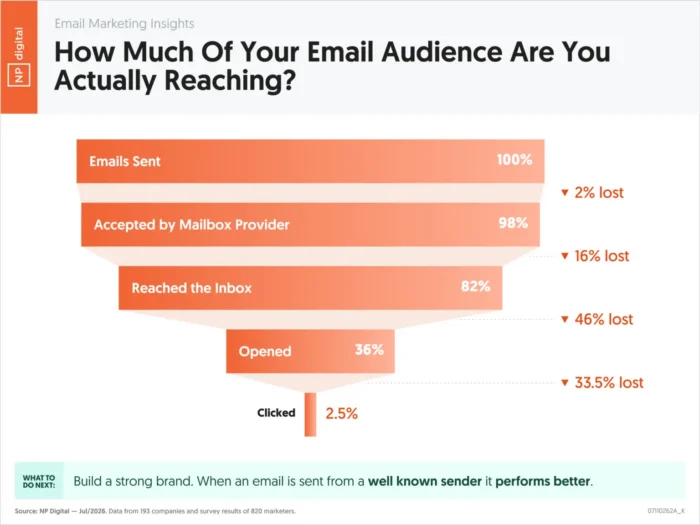
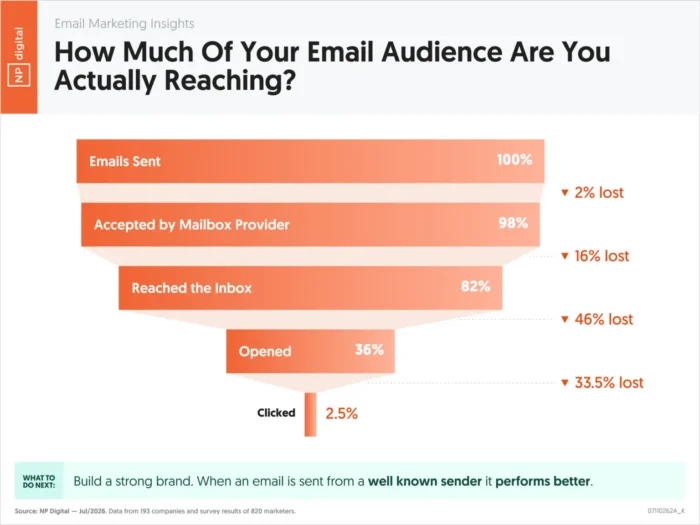
Here’s how much audience a typical send loses before anyone has a chance to engage. Of emails sent, 98 percent get accepted by the mailbox provider, but only 82 percent actually reach the inbox. Only 36 percent get opened, and only 2.5 percent get clicked. Every stage between send and click loses part of your audience, and most of that loss happens before a subscriber ever sees the email.
Inbox providers are changing the rules on this. They increasingly use AI to decide which emails reach the inbox, which get filtered, and which senders get trusted at all. Marketers tend to rank authentication and open rate as what matters most, but inbox providers weight sender and domain reputation and spam complaints far more heavily. Trust signals like replies and complaint rates are quietly deciding who gets filtered, whether marketers are watching them or not.
Email deliverability best practices rest on authentication (SPF, DKIM, DMARC), sender reputation built through engagement and damaged by complaints, and list quality, where a smaller engaged audience consistently outperforms a larger inactive one. Good list hygiene reinforces each of these: segment by engagement, purchase behavior, and activity recency, then back that up with re-engagement campaigns, sunset policies, and suppression strategies for contacts who’ve gone quiet.
Higher send frequency can shrink your effective audience instead of growing it. Open rates decline as cadence increases, from 33.8 percent at one send a week down to 26.2 percent at five or more, and volume without value trains subscribers to stop opening. Affiliate emails and cold emails carry the highest unsubscribe and spam complaint rates of any email type. The most common mistakes behind poor email deliverability are excessive frequency, poor segmentation, purchased lists, misleading subject lines, and ignoring inactive subscribers instead of suppressing them.
Building the AI Email Marketing Operating System
Personalization, automation, and deliverability only work as one system. Personalization without deliverability never gets read. Automation without personalization feels robotic. Deliverability without automation can’t scale past what a person can manually manage.
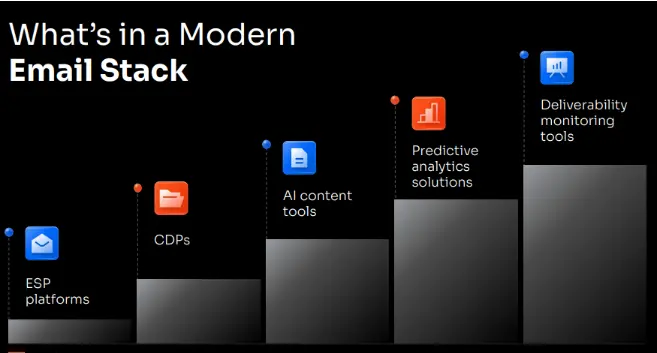
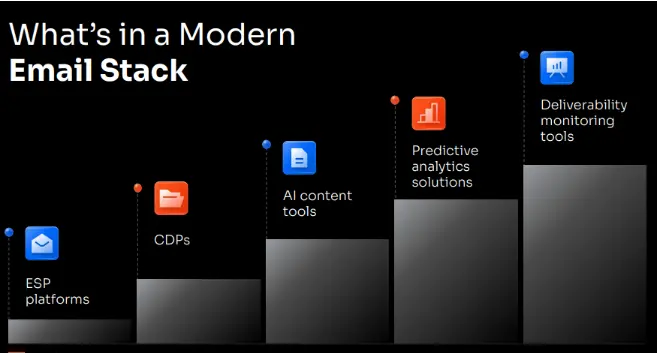
A modern email stack needs five pieces working together: an ESP platform, a customer data platform, AI content tools, predictive analytics, and deliverability monitoring. Most teams already have some of these, but few have them talking to each other.
That disconnect shows up in where AI investment is actually going. Teams are pouring the most effort into content creation and paid media optimization, the two areas with the highest percentage of teams applying AI. Personalization and marketing automation get far less investment, despite rating comparable or higher on effectiveness. Investment is going toward the easiest wins, even though personalization and automation are rated as more effective.
The future email team blends strategy, data, automation, and AI into a single connected workflow from the start.
The 90-Day Action Plan
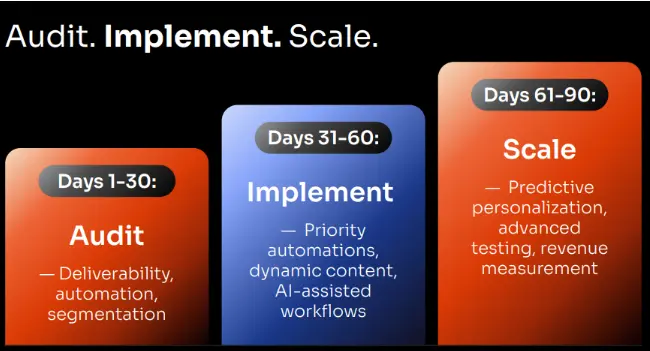
Trying to fix personalization, automation, and deliverability all at once is how most programs stall. Sequencing beats doing everything simultaneously.
- Days 1 to 30 (Audit): Review deliverability, automation, and segmentation to find the weakest link in your current program.
- Days 31 to 60 (Implement): Build the priority automations, dynamic content, and AI-assisted workflows the audit surfaced.
- Days 61 to 90 (Scale): Layer in predictive personalization, advanced testing, and revenue measurement once the foundation holds.
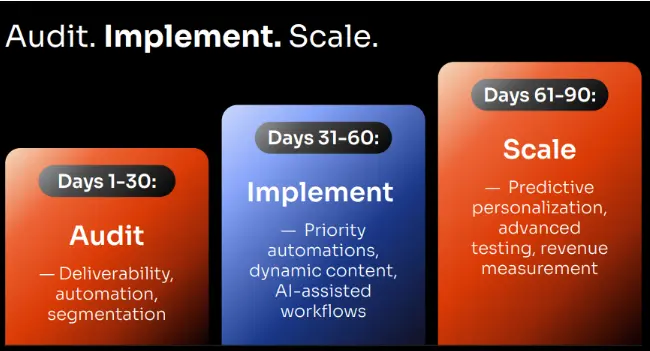
The sequencing matters more than the individual tactics. Predictive personalization and recommendations account for the largest single share of incremental business impact among AI email initiatives, at 31 percent, and impact compounds as each subsequent initiative builds on the last, reaching 100 percent cumulative impact across all five. Sequence each initiative starting with whichever is easiest to implement, and let each one build on the last.
O que observar agora
- Acompanhe de perto as políticas de entregabilidade dos provedores de e-mail e as métricas de reputação do remetente, que se tornam ainda mais influentes.
- Monitore a adoção e a evolução das ferramentas de IA para personalização preditiva e automação de fluxos de ciclo de vida do cliente.
- Observe a integração de plataformas de dados do cliente (CDPs) com sistemas de e-mail marketing para construir perfis de usuário mais ricos e acionáveis.
Perguntas frequentes
O que é personalização de e-mail por IA?
A personalização de e-mail por inteligência artificial utiliza dados comportamentais e preditivos, como histórico de navegação, risco de churn ou probabilidade de compra, para customizar linhas de assunto, conteúdo e ofertas para cada assinante individualmente.
Como posso melhorar a entregabilidade dos meus e-mails?
Para otimizar a entregabilidade, concentre-se na autenticação (SPF, DKIM, DMARC), construa uma reputação de remetente sólida através de engajamento consistente e mantenha a qualidade da lista com campanhas de reengajamento e supressão de contatos inativos.
Quais automações de e-mail marketing oferecem o maior ROI?
Automações de carrinho abandonado, séries de boas-vindas e e-mails de upsell ou reposição pós-compra são as que geram a maior parcela da receita de automação. Abandono de navegação e reengajamento também são fluxos de alto valor.
What is AI email personalization?
AI email personalization uses behavioral and predictive data, like purchase likelihood, churn risk, or browsing history, to tailor subject lines, content, and offers to each subscriber individually.
How do I improve email deliverability?
Focus on authentication (SPF, DKIM, DMARC), sender reputation built through consistent engagement, and list quality maintained through regular re-engagement campaigns and suppression of inactive contacts.
What email automations have the highest ROI?
Abandoned cart, welcome series, and post-purchase upsell or replenishment automations drive the largest share of automation revenue. Browse abandonment and re-engagement automations round out the five workflows worth building first.
How much should I automate vs. send as campaigns?
It depends on company size and program maturity, but the trend is clear: larger, more mature email programs shift the majority of their revenue toward automation. Businesses over $51 million in revenue get 71 percent of email revenue from automation, compared to 49 percent from campaigns at businesses under $1 million.
{
“@context”: “https://schema.org”,
“@type”: “FAQPage”,
“mainEntity”: [
{
“@type”: “Question”,
“name”: “What is AI email personalization?”,
“acceptedAnswer”: {
“@type”: “Answer”,
“text”: “
AI email personalization uses behavioral and predictive data, like purchase likelihood, churn risk, or browsing history, to tailor subject lines, content, and offers to each subscriber individually.
”
}
}
, {
“@type”: “Question”,
“name”: “How do I improve email deliverability?”,
“acceptedAnswer”: {
“@type”: “Answer”,
“text”: “
Focus on authentication (SPF, DKIM, DMARC), sender reputation built through consistent engagement, and list quality maintained through regular re-engagement campaigns and suppression of inactive contacts.
”
}
}
, {
“@type”: “Question”,
“name”: “What email automations have the highest ROI?”,
“acceptedAnswer”: {
“@type”: “Answer”,
“text”: “
Abandoned cart, welcome series, and post-purchase upsell or replenishment automations drive the largest share of automation revenue. Browse abandonment and re-engagement automations round out the five workflows worth building first.
”
}
}
, {
“@type”: “Question”,
“name”: “How much should I automate vs. send as campaigns?”,
“acceptedAnswer”: {
“@type”: “Answer”,
“text”: “
It depends on company size and program maturity, but the trend is clear: larger, more mature email programs shift the majority of their revenue toward automation. Businesses over $51 million in revenue get 71 percent of email revenue from automation, compared to 49 percent from campaigns at businesses under $1 million.
”
}
}
]
}
Conclusão
A inteligência artificial eleva o potencial de qualquer programa de e-mail marketing que já possua fundamentos sólidos. É crucial entender que personalização, automação e entregabilidade operam como um sistema integrado; uma falha em qualquer um desses pilares limita severamente a eficácia dos outros. Marcas que constroem e aprimoram esses pilares de forma sequencial, em vez de tentar resolver tudo ao mesmo tempo, experimentam ganhos exponenciais e um crescimento acelerado.
Para aqueles que buscam aprimorar seu programa de e-mail e não têm certeza de onde começar, ou querem aprofundar a auditoria dos fundamentos, o guia de e-mail marketing da NP Digital é um excelente ponto de partida para identificar e fortalecer as áreas mais fracas.
Fonte: Neil Patel